
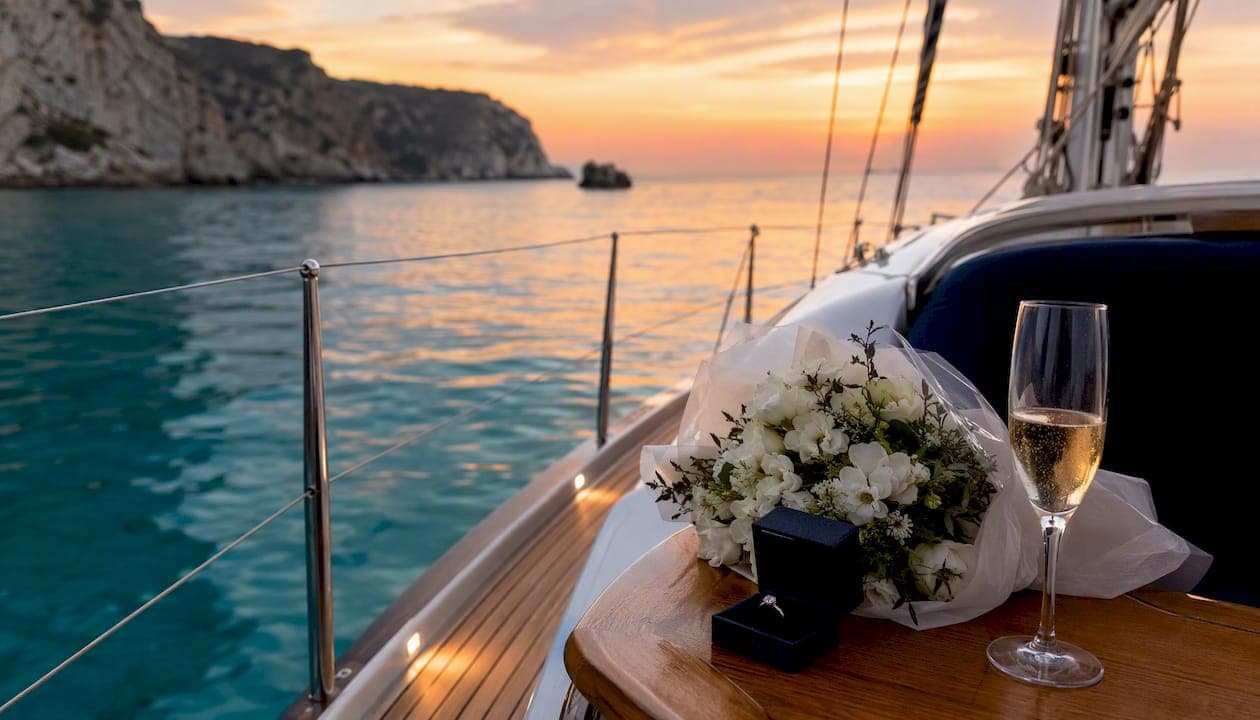
A private, captained charter timed for golden hour is the clearest path to an intimate, photo-ready proposal on a boat. The setting does the heavy lifting: warm light dancing on the water, no strangers in the background, and a captain who knows exactly when to slow the engine and give you the deck. A significant portion of people now consider a public proposal a major "ick," which makes the privacy of a chartered vessel more than a luxury — it's the smart call.
Start here:
- Book a private charter with a licensed captain. A USCG-licensed captain handles navigation so you stay fully present for the moment.
- Hire a discreet photographer or set up a hidden camera. Coordinate their position before you board so nothing feels staged when it counts.
- Lock in a primary date and a backup date. Keep the ring in a secure, zipped pocket until the anchored moment — never hold an open box near the railing while underway.
Key Takeaways
A private, captained charter timed for golden hour gives you the intimacy, the light, and the freedom to be fully present for the most important question you'll ever ask.
| Point | Details |
|---|---|
| Choose a private charter | Nearly 29% of people consider a public proposal a major "ick" — a private vessel removes that risk entirely. |
| Time it for golden hour | Sunset light is the highest-ROI timing for proposal photos; confirm weather 48–72 hours ahead with your captain. |
| Secure the ring properly | Keep the ring zipped and tethered until the captain anchors; never hold an open box near the railing underway. |
| Book early | Sunset slots fill 3–6 weeks ahead on busy waterways; holiday periods require even earlier booking. |
| Desboattours for Sarandë | Private charters from Sarandë with a licensed captain, customizable itineraries, and optional photographer coordination. |
Table of Contents
- What are the best proposal on a boat ideas?
- How do you plan a boat proposal step by step?
- Which boat type is right for your proposal?
- What does a boat proposal typically cost in the U.S.?
- How do you coordinate a photographer for a boat proposal?
- How do you keep the ring safe on a boat?
- When is the best time for a boat proposal, and what's your backup plan?
- What does your day-of timeline look like?
- What should you actually say when you propose?
- Safety, etiquette, and a few legal notes to check
- Planning a destination proposal? Desboattours makes it easy in Sarandë
- The moment matters more than the plan
- Sources
What are the best proposal on a boat ideas?
The Knot's guide to boat proposals catalogs 12 distinct concepts, each with its own mood and logistics. Here's the full menu with quick suitability notes so you can match the idea to your relationship:
- Sunset sail — Best for: romance and photos. Budget: medium–high. Privacy: private. Time the kneel for the exact moment the sun touches the horizon.
- Private yacht charter — Best for: luxury and total privacy. Budget: high. Privacy: fully private. Hire a photographer to ride along as a "deckhand."
- Pontoon picnic — Best for: relaxed, laid-back couples. Budget: low–medium. Privacy: private. Anchor in a calm cove, spread a blanket, and let the water do the rest.
- Kayak or canoe for two — Best for: adventure-loving couples. Budget: low. Privacy: private. A shoreline photographer with a 70–200mm lens captures the moment without crowding the water.
- Gondola — Best for: classic romance in an urban waterway. Budget: medium. Privacy: semi-private. Coordinate a cue with the gondolier to pause at a scenic bend.
- Waterfall approach — Best for: nature-first couples. Budget: medium. Privacy: semi-private. Time the proposal as the boat idles near the falls for natural sound cover.
- Bridge-pass proposal — Best for: landmark lovers. Budget: medium. Privacy: shared. Coordinate the cue with the captain so the kneel happens as you pass under the arch.
- Sea cave or grotto — Best for: dramatic, unforgettable settings. Budget: medium. Privacy: semi-private. The echo and filtered light make it genuinely cinematic.
- Anchored cove with picnic — Best for: slow, intimate moments. Budget: low–medium. Privacy: fully private. Pack a small cooler, a blanket, and champagne; let the cove feel like your own world.
- Bow-kneel moment — Best for: classic, cinematic energy. Budget: medium–high. Privacy: private. The bow of a moving boat frames the horizon perfectly behind you.
- Ferry-surprise proposal — Best for: spontaneous-feeling moments on a budget. Budget: low. Privacy: public. Works best on a quiet crossing; pick an off-peak sailing to minimize crowds.
- Wildlife or dolphin encounter — Best for: couples who love nature. Budget: medium. Privacy: semi-private. Propose during a natural pause in the action when attention is already on the water.
How do you plan a boat proposal step by step?
Five steps take you from idea to "yes" without leaving anything to chance. Private charters are consistently recommended for intimacy because a hired captain handles navigation while you stay fully in the moment.
Step 1: Decide your style and guest list
- Confirm your partner is comfortable on the water (motion sickness is real — address it early).
- Decide: just the two of you, or a small group waiting at the dock for the celebration?
- Choose a concept from the list above that fits your relationship's personality.
Step 2: Book the right boat and captain
- Search for USCG-licensed charter operators in your area or destination.
- Request a private booking — not a shared tour — and confirm the captain's experience with proposals.
- Pay the deposit and get cancellation and rescheduling terms in writing.
- Sunset slots on busy waterways fill 3–6 weeks ahead, so book early, especially for peak summer and holiday windows.
Step 3: Coordinate photographer and décor
- Hire a photographer experienced with maritime shoots or ask the charter if they work with one regularly.
- Brief the photographer on the cue, the hiding spot, and the lens setup (more on this in the photography section below).
- Arrange any add-ons: champagne, roses, candles in lanterns, or a small floral arrangement secured to the deck.
Step 4: Prepare ring logistics and rehearsal
- Practice your key phrases aloud once or twice in private — then speak from the heart on the day.
- Secure the ring in a zipped, tethered pocket or a waterproof pouch until the anchored moment.
- Confirm with the captain where and when they'll slow or anchor for the proposal.
Step 5: Post-yes celebration and contingency
- Plan the first 30 minutes after the "yes": champagne on deck, staged photos, a call to family.
- Set a backup date and confirm the photographer can reschedule within the same window.
- If weather forces a change, have a dockside venue in mind — some hospitality spots offer rose petals and champagne setups when contacted privately in advance.
Which boat type is right for your proposal?
Matching the vessel to your goals makes everything easier. Here's how the main categories stack up:
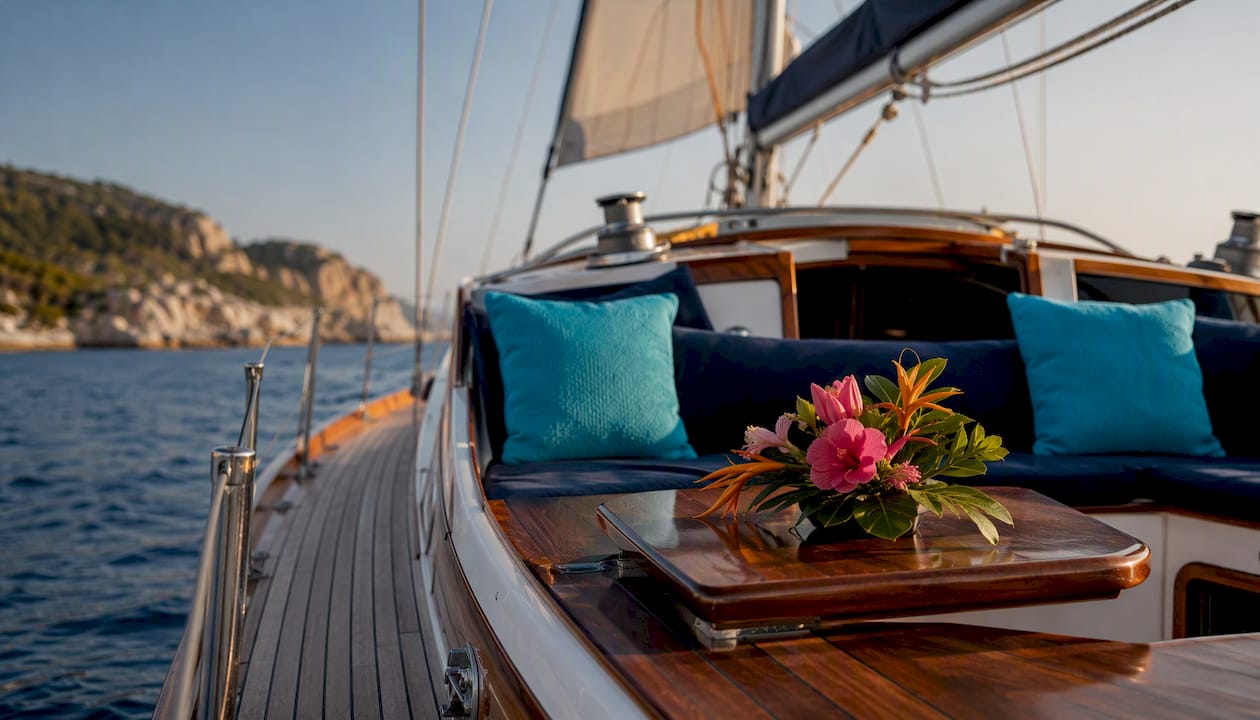
Private sailboat
Pros: Quiet, elegant, and deeply romantic. The gentle motion of a sail feels cinematic, and the lack of engine noise means your words carry clearly. Stability is good in calm conditions. Cons: Wind-dependent; a calm day can mean slow-going. Space on deck is limited for large setups.
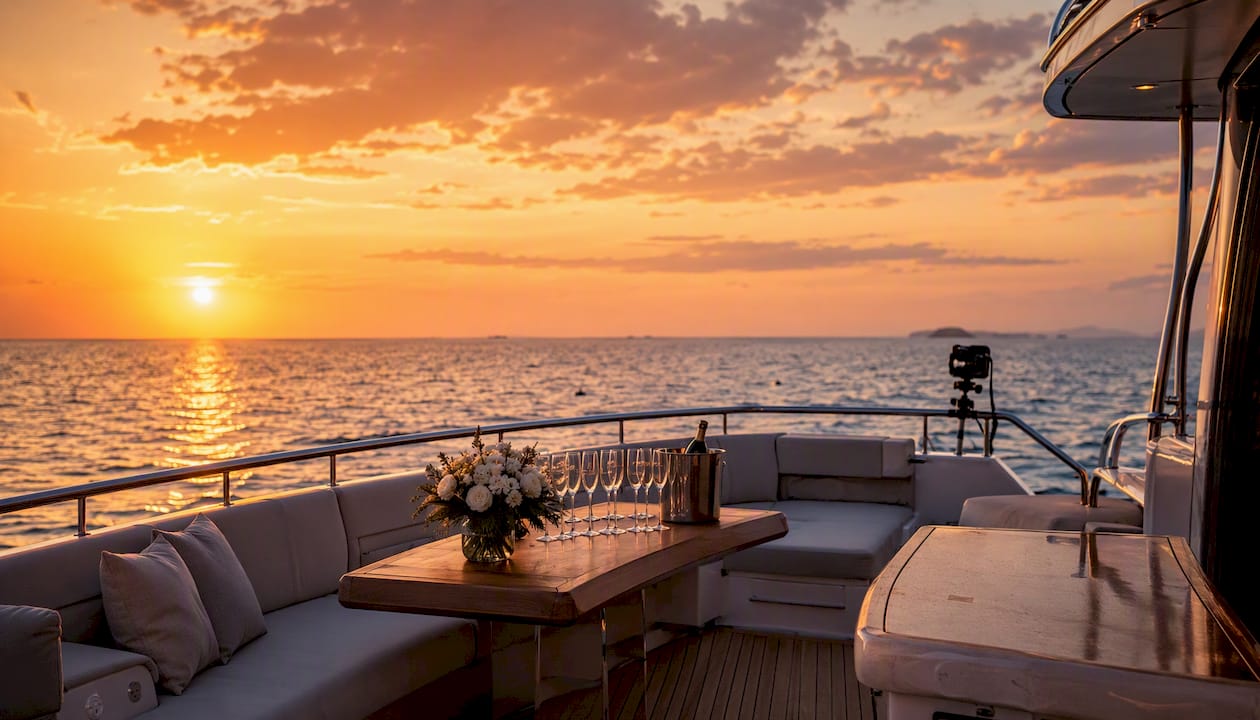
Motor yacht
Pros: Fast, stable, and spacious enough for décor, a photographer, and a small celebration group. Excellent photo potential from multiple angles on deck. Cons: Higher cost tier; engine noise can require timing the proposal at anchor.
Pontoon boat
Pros: Wide, flat deck makes it the most stable platform for kneeling and photography. Affordable to rent. Easy to decorate. Cons: Less glamorous visually; works best in calm, sheltered water rather than open ocean.
Catamaran
Pros: Very stable, good deck space, and a wide beam that gives a photographer room to work. Great for small groups joining the celebration. Cons: Larger footprint means it can feel less intimate with just two people.
Kayak or canoe
Pros: Lowest cost, highest adventure factor, and completely private. A shoreline photographer with a long lens captures everything without being on the water. Cons: Zero stability for kneeling — plan to propose while both kayaks are side by side and stationary.
Gondola
Pros: Built-in romance, a gondolier who can coordinate a pause, and a classic urban-waterway backdrop. Cons: Semi-public setting; other gondolas may be nearby.
Small tour boat or ferry
Pros: Budget-friendly and no booking complexity. Cons: Public setting with other passengers — privacy is limited, and timing is out of your hands.
Pro Tip: Choose a captained private charter over a self-drive rental whenever the proposal is the main event. A captain positions the boat for the best light, handles anchoring, and steps away discreetly — a self-drive rental puts navigation on you at exactly the wrong moment.
What does a boat proposal typically cost in the U.S.?
Prices vary by vessel type, location, time of day, and add-ons. These are typical U.S. ranges with seasonal variance — expect higher rates in summer and in major coastal cities.
| Vessel type | Typical U.S. range | Notes |
|---|---|---|
| Kayak or canoe rental | Under $100–$200 | Self-guided; photographer cost is separate |
| Pontoon boat | $200–$600 | Calm-water rentals; captained options cost more |
| Private sailboat | $600–$1,000 | NYC weekday couples specials start at $600 for 2 hours, including a USCG-licensed captain, fuel, and docking fees |
| Small yacht charter | $2,000–$3,500 | Depends on vessel size, styling, and add-ons |
| Gondola | $100–$300 | Urban waterways; typically 30–60 minutes |
Key pricing drivers to watch:
- Sunset premium: Golden-hour slots often carry a 15–30% surcharge over daytime rates.
- Add-ons: A professional photographer adds $300–$800 on average; décor packages (roses, champagne, candles) typically run $100–$400 depending on the charter.
- Peak-season surcharges: Summer weekends and holidays push rates to the top of each range.
- Deposit and cancellation terms: Most charters require a 25–50% deposit at booking. Ask specifically about weather-related rescheduling — a good charter will offer a free reschedule window for weather cancellations rather than a flat refund.
How do you coordinate a photographer for a boat proposal?
Getting the photo without ruining the surprise takes a little planning, but it's very doable. Photographers experienced with maritime proposals recommend planning lens choices and hiding positions before you board — on a small craft, a 70–200mm lens lets them capture candid frames from a distance without crowding the deck.
Your coordination options:
- On-board photographer posing as a guest or crew member. The most reliable option. Brief them fully before boarding and agree on a signal (a phrase, a hand gesture) that tells them the moment is coming.
- Off-boat photographer on a separate vessel or shoreline. Works beautifully for bow proposals or anchored-cove moments. Requires a second boat or a clear sightline from shore.
- Remote trigger or hidden action camera. A GoPro mounted on the mast or railing can capture wide-angle footage. Pair it with a photographer for close-up stills.
- Captain-assisted staged photos after the moment. The lowest-stress option if a photographer isn't in the budget. Ask the captain to take posed photos once you're both celebrating — the light is still good and the emotion is real.
Photographer briefing checklist:
- Share the exact cue (word, gesture, or captain's signal) that starts the shoot.
- Agree on the hiding spot or position before boarding.
- Confirm lens choice: 70–200mm for candid distance shots; 35–50mm for intimate posed frames after the moment.
- Set shutter priority mode for golden-hour conditions to avoid motion blur on a moving deck.
- Discuss wet-condition protocols — a waterproof bag for the camera body is worth the extra weight.
Private proposal packages on iconic waterways often bundle discreet photographer coordination directly into the charter, timing the shoot around landmark backdrops. Ask your charter if they offer a similar arrangement before hiring separately.
How do you keep the ring safe on a boat?
The ring is the one thing you absolutely cannot lose overboard. A few simple precautions make the whole day stress-free.
Ring safety options:
- Secure zip pocket with a small tether. A carabiner clipped to a belt loop and attached to the ring box is low-tech and completely reliable.
- Waterproof sealed pouch. Protects against spray and accidental drops into water. Transfer to the box just before the moment.
- Decoy or fake box. Carry a small decoy box in your jacket pocket to deflect any curious glances; keep the real ring in a separate secure location.
- Ring on a cord necklace. Worn under a shirt, it stays close to your body and is impossible to drop. Swap to the box just before you kneel.
- Staged ring swap after the "yes." Propose with a placeholder (a simple band or even verbally), then present the real ring once you're safely anchored or back at the dock.
Do and don't list for small craft:
- Do keep the ring zipped and tethered until the captain confirms you're anchored or at a slow idle.
- Do ask the captain about secure storage options on board — most have a lockable compartment.
- Don't hold an open ring box near the railing while the boat is underway.
- Don't place the ring box on a surface without securing it first — a wake from a passing vessel can send it sliding.
Pro Tip: Ask the captain to slow to idle or anchor before you reach for the ring. A brief, calm moment on the water is worth more than a dramatic kneel on a rocking deck.
When is the best time for a boat proposal, and what's your backup plan?
Timing shapes everything from the photos to the mood. Golden hour — roughly 30–60 minutes before sunset — gives you warm, flattering light that makes every photo look effortless. Confirm the weather 48–72 hours ahead with your captain and build a reschedule window into your plan from the start.
Timing checklist:
- Check the local sunset time for your date and work backward: board 90 minutes before sunset to allow for travel time to your spot.
- Review tide and current schedules for your waterway — some locations are calmer at specific tidal stages.
- Check harbor ferry schedules and peak traffic windows; avoid proposing during a busy crossing or near a commercial shipping lane.
- If your location requires proximity to a bridge, landmark, or restricted area, ask the charter what permits, if any, apply.
Contingency planning:
- Book a primary date and a backup date at the same time — confirm both with the photographer.
- Ask the captain for a weather clause in the contract: free reschedule within a defined window if conditions are unsafe.
- Agree on a communication plan for last-minute changes that doesn't tip off your partner (text a trusted friend who can relay the message).
- Identify a dockside backup venue — a waterfront restaurant or terrace — in case the charter is cancelled entirely.
- Confirm the photographer's reschedule availability matches your backup date before you finalize either booking.
What does your day-of timeline look like?
A 2-hour sunset charter gives you a natural structure. Here's a sample minute-by-minute timeline you can adapt:
- T-60 min: Arrive at the marina early. Confirm setup with the captain and photographer. Check ring location.
- T-45 min: Board and settle in. Let your partner explore the boat while you do a final check with the crew.
- T-30 min: Depart. Enjoy the cruise — keep the mood relaxed and conversational.
- T-15 min: Captain moves to the proposal position (anchor spot or scenic heading). Photographer moves into position.
- T-0: Golden-hour light peaks. Captain gives the agreed cue. You propose.
- +5 min: Champagne on deck. Photographer captures the celebration.
- +30 min: Staged portraits while the light is still warm.
- +60 min: Begin return to dock. Call family, share the news.
- +120 min: Dock arrival. Friends or family waiting if part of the plan.
Packing checklist:
- Ring in a secure, tethered location
- Layered clothing for the breeze (it gets cooler on the water after sunset)
- Non-slip shoes
- Sunscreen
- Spare batteries or a charged power bank for the camera
- Motion-sickness medication (take it 30–60 minutes before boarding if needed)
- Small towel and napkins
- Sealed case or dry bag for phones
Arrival logistics: Drop off at the marina separately if the surprise depends on it. If friends or family are joining the dock celebration, brief them on the timeline and give them a "we're heading back" signal so they're ready.
What should you actually say when you propose?
You don't need a speech. You need a few honest sentences that sound like you. Here are five short scripts to spark your own wording:
- Classic romantic: "Every moment I've spent with you has felt like the best part of my life. I want that to be the rest of my life. Will you marry me?"
- Playful and adventurous: "I figured if we can survive, we can survive anything. Let's make it official — will you marry me?"
- Sentimental and future-focused: "I keep thinking about all the places we haven't been yet, and I want to go to every single one of them with you. Marry me?"
- One-liner with warmth: "I've been practicing this for weeks and I still just want to say: I love you, and I want to do this forever. Will you marry me?"
- Quiet and intimate: "You already know how I feel. I just want to ask you properly, out here, where it's just us."
Pro Tip: Rehearse your key phrases once or twice in private, then put the script away. Speaking from the heart — even imperfectly — lands better than a memorized monologue.
Personalize any of these by dropping in a specific memory (the trip where you knew, the inside joke only you two share, or a promise about somewhere you'll go together). That one detail makes the words yours.
Safety, etiquette, and a few legal notes to check
A smooth proposal on the water starts with a safe one. None of this is complicated, but skipping it creates avoidable stress.
Safety essentials:
- Confirm life jackets are on board and accessible — USCG regulations require them for all passengers on recreational vessels.
- Wear non-slip shoes; wet decks are slippery, especially when you're kneeling.
- Secure loose items (bags, décor, the ring box) before the boat gets underway.
- Watch the handrail when you kneel — on a moving vessel, balance shifts unexpectedly.
- If alcohol is part of the celebration, save it for after the moment, not before. Stability and clear-headedness matter more than nerves.
Etiquette toward crew and other boaters:
- Brief the captain and crew privately before your partner boards — they need to know the plan to help execute it.
- Avoid blocking passages or work areas on the vessel during the proposal.
- Respect private docks and restricted anchorage areas; ask the captain before approaching any marked zone.
- If other guests are present on a shared vessel, be discreet — not everyone wants to be part of a surprise.
Legal and permit notes:
- Check local harbor authority rules for your waterway, particularly if you plan to anchor near a bridge, landmark, or restricted area.
- Review USCG guidance on vessel operation and passenger limits for the boat type you're chartering.
- Ask the charter directly what permits, if any, are required for your planned route and any special stops.
Planning a destination proposal? Desboattours makes it easy in Sarandë
If your proposal vision includes turquoise Ionian water, sea caves, and a private cove that feels like the edge of the world, Sarandë on the Albanian Riviera delivers all of it. Desboattours offers private charter options with a licensed captain, customizable itineraries, and the kind of local knowledge that puts you in the right spot at the right moment.
The couples-focused tours include free drinks, snorkeling gear, sunbeds, and umbrellas — and private charters can be tailored around a proposal timeline, including photographer coordination and a quiet anchored moment in a secret cove. The Albanian Riviera's light at golden hour is genuinely spectacular, and the sea caves along the coast offer backdrops that no studio could replicate. Check availability and reach out to Desboattours via WhatsApp to discuss private-charter pricing and discreet proposal coordination. Verify current travel and harbor entry requirements for Albania before booking, and note that availability is seasonal.
The moment matters more than the plan
The couples who remember their proposals most vividly aren't the ones who had the most elaborate setup. They're the ones who were fully present. A private charter with a licensed captain removes the logistical weight from your shoulders so you can actually be there, at that moment, on the water, with the person you love.
Privacy and a good captain are the two highest-value investments you can make for a stress-free proposal. Everything else — the champagne, the flowers, the photographer — is wonderful, but optional. Get those two things right, and the rest takes care of itself.
Sources
These resources support the pricing, ideas, and coordination guidance throughout this article:
- Boat Proposal Ideas — The Knot
- Romantic Boat Ride Proposal Ideas: The Ultimate Guide to Popping the Question at Sea
- Boat Proposal NYC | Private Sailboat | Couples Special $600
- Marriage Proposal on the Seine
- How to Plan a Surprise Proposal on Sydney Harbour: Private Boat Charter Guide - Tiger Catamarans